
Open Ear Air Conduction Earbuds sit outside the ear canal, sending sound through the air rather than sealing the ear with an in-ear tip. Their small speakers rest near the ears, leaving the canal open. You can hear a podcast while noticing a bicycle bell, a colleague calling, or traffic nearby. That awareness can be useful. It does not make listening risk-free, replace attention, or protect hearing from loud sound.
The category is part of a much larger audio market. Grand View Research’s Wireless Headphones Market report estimated that market at about USD 74.9 billion in 2023, with continued growth projected through 2030. That figure covers wireless headphones broadly, not open-ear models alone. For hearing-health context, the World Health Organization’s 2021 World Report on Hearing projects that nearly 2.5 billion people may have some degree of hearing loss by 2050. WHO hearing-care specialist Dr. Shelly Chadha has urged action “to prevent and address hearing loss throughout the life course.” Open-ear design is not a cure or a guarantee of safer listening.
Fit and sound leakage matter. So do battery life, microphone quality, and comfort after an hour of wear. A useful test is simple: can you hear your surroundings without turning the volume up to overcome them? Not always. This guide explains how air conduction works, where these earbuds fit, and what to check before choosing a pair.
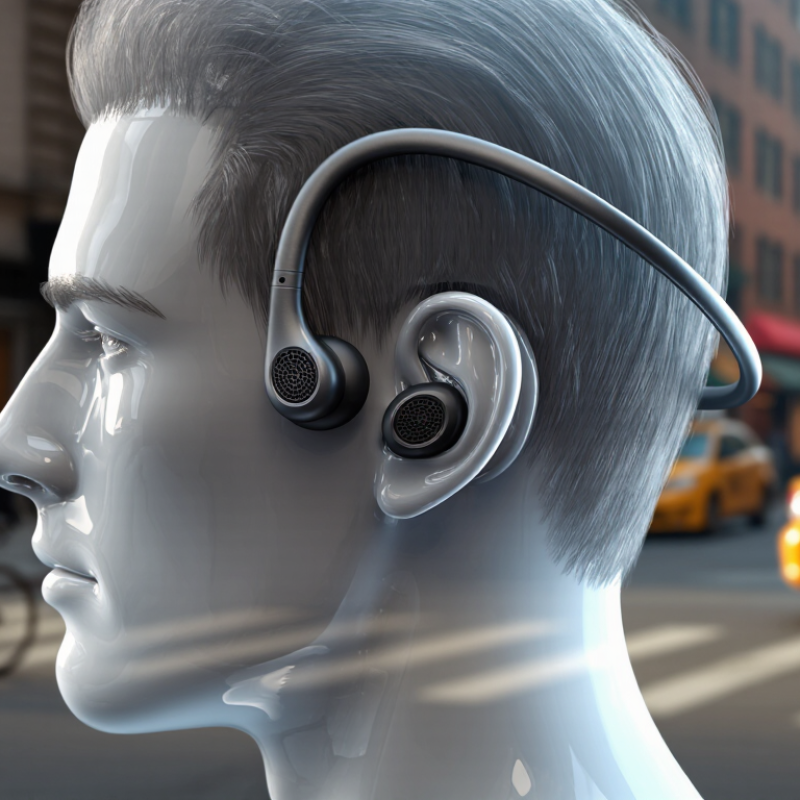
Open-ear air-conduction earbuds deliver sound through the air without plugging the ear canal. Small speaker drivers sit near the ears, often held in place by curved hooks or a lightweight band. Sound travels from each driver toward the outer ear, then through the ear canal to the eardrum. No seal is formed. That is the defining design choice.
The open structure can make it easier to hear nearby sounds, such as a cyclist’s bell or someone speaking across a room. It also means the sound may be audible to people sitting close by, especially at higher volume. The housing must balance stability with comfort: a hook that feels secure during a walk might press uncomfortably after an hour. Small details matter.
Fit affects what you hear. If a driver sits too far from the ear, music can seem thin, particularly in the bass; shifting it slightly may change the sound. These earbuds do not place sound directly into the ear canal, but they still use ordinary audio drivers and should be kept at a comfortable volume. “Open ear” can sound like a complete description, though shapes and positioning vary. A quick fit check in a quiet room is useful, but real-world noise can make the experience different.
| Design Dimension | Definition or Structure | How It Works | Practical Implications |
|---|---|---|---|
| Basic definition | Wearable audio devices that deliver sound through the air while leaving the ear canal open. | Small speakers direct sound toward the ears without forming an in-ear seal. | Users can hear audio while remaining more aware of nearby sounds than they typically would with sealed in-ear earbuds. |
| Sound transmission | Air-conduction audio, rather than bone-conduction audio. | Speaker vibrations create sound waves in the air, which travel through the outer ear and ear canal to the eardrum. | The sound pathway resembles that of conventional loudspeakers, although the speakers are positioned close to the ears. |
| Ear-canal design | No eartip is inserted into the ear canal, and the canal is not intentionally sealed. | The open fit allows environmental sound to enter the ear naturally. | It can feel less occlusive, but it does not provide the passive isolation of a well-sealed in-ear design. |
| Speaker placement | Compact drivers are positioned near the ear, commonly beside or just outside the ear canal. | Directional placement sends audio toward the listener while limiting, but not eliminating, sound heard by others. | Fit and placement can affect perceived volume, bass response, and sound leakage. |
| Wearing structure | Depending on the design, the earbuds may use ear hooks, clips, or a band that rests around the head or neck. | The structure holds the speakers in position without requiring an in-canal seal. | Stability, comfort, and suitability for glasses or different ear shapes vary by design and individual fit. |
| Environmental awareness | Open-ear construction leaves the ears physically unobstructed. | Ambient sounds are not blocked by an inserted eartip, although playing audio can still mask some sounds. | Awareness may be useful in settings where hearing surroundings matters, but it does not replace attention or hearing protection. |
| Isolation and noise reduction | Most open-ear air-conduction designs provide limited passive isolation because the ear canal remains open. | Some models use signal processing or directional speaker design, but these features do not create a physical seal. | Background noise may remain noticeable, especially in loud environments; open-ear earbuds are not generally a substitute for hearing protection. |
| Sound leakage | Audio can escape into the surrounding area because the speakers are not enclosed within the ear canal. | Leakage depends on listening volume, speaker direction, distance, and the surrounding environment. | At higher volumes, nearby people may hear some of the audio. |
| Acoustic trade-offs | The open fit prioritizes an unobstructed ear over a sealed acoustic chamber. | Without an ear-canal seal, low-frequency response and isolation can differ from those of sealed in-ear earbuds. | Perceived sound quality varies with fit, driver design, volume, and listening conditions. |
| Common use contexts | Often chosen for walking, commuting, work, or exercise when users prefer not to insert earbuds into the ear canal. | The open design permits ambient sound to reach the listener alongside audio playback. | Suitability depends on the activity and setting; users should keep volume at a safe level and follow local safety rules. |
Small speakers sit just outside the ear canal. Sound travels through the air and follows the ear’s usual hearing pathway.
No. The canal stays uncovered, so nearby sounds may be easier to notice.
In-ear earbuds sit inside the canal and form a closer seal. Open-ear models feel less enclosed, but may provide less bass.
Open-ear air-conduction models send sound through the air. Bone-conduction models send vibrations through the cheekbones.
They might, especially when the volume is high or someone is sitting close. A quiet room can reveal sound leakage.
The speaker may sit too far from your ear. A small position change can improve bass, though results vary.
Not necessarily. A hook may feel secure at first but press after an hour. Fit is personal, and a quick check may not predict everything.
No. Open ears do not make loud listening harmless. Keep volume moderate, especially in noisy places. Don’t turn it all the way up.
Open Ear Air Conduction Earbuds are designed to deliver sound while leaving the ear canal uncovered. Small speakers sit just outside the ears and send sound through the air into the ear, where it travels along the usual hearing pathway. Their main parts typically include a speaker unit, a lightweight frame or ear hook, and controls or a battery housed in the outer section. The open fit can feel less enclosing than earbuds that sit inside the ear.
Unlike in-ear earbuds, open-ear air-conduction models do not seal the ear canal. Unlike bone-conduction earbuds, they transmit sound through air rather than vibrations through the bones around the ear. This design can suit activities where awareness of nearby sounds is useful, such as walking or working in shared spaces. However, the open fit may make audio harder to hear in noisy surroundings, and sound can be audible to people nearby. They may also provide less bass and noise isolation than sealed earbuds.