
The global demand for Over Ear ANC Headphones is moving beyond simple volume and bass. Buyers now compare microphone quality, battery endurance, comfort, codec support, and measurable noise reduction. Grand View Research identifies active noise cancellation as a major growth segment within the broader headphone industry. MarketsandMarkets also forecasts continued expansion, driven by remote work, travel, gaming, and premium personal audio. The numbers vary between reports. Their methods and market definitions are not identical. That limitation deserves attention.
China remains a significant sourcing base for this category. Its ecosystem connects acoustic engineers, chip suppliers, battery producers, mold factories, and final-assembly plants. This creates practical advantages for international buyers. A factory can often move from prototype tuning to pilot production quickly. However, supplier claims require verification. Buyers should request independent frequency-response charts, ANC attenuation results, battery-cycle data, and sample-testing records. A polished showroom cannot replace a repeatable test report.
Dr. Amar Bose, founder of Bose Corporation, famously said, “The best sound is the sound you don’t hear.” His statement captures the purpose of effective noise control, but modern buyers need more than silence. They need natural transparency modes, stable Bluetooth connections, safe battery designs, and consistent performance across production batches. This guide examines China’s top Over Ear ANC Headphones suppliers through those practical criteria. It considers engineering experience, certification readiness, customization capability, quality control, and export reliability. Some supplier rankings may still change as technologies evolve. That is not a weakness to hide. It is a reason to verify every claim before signing a purchase agreement.
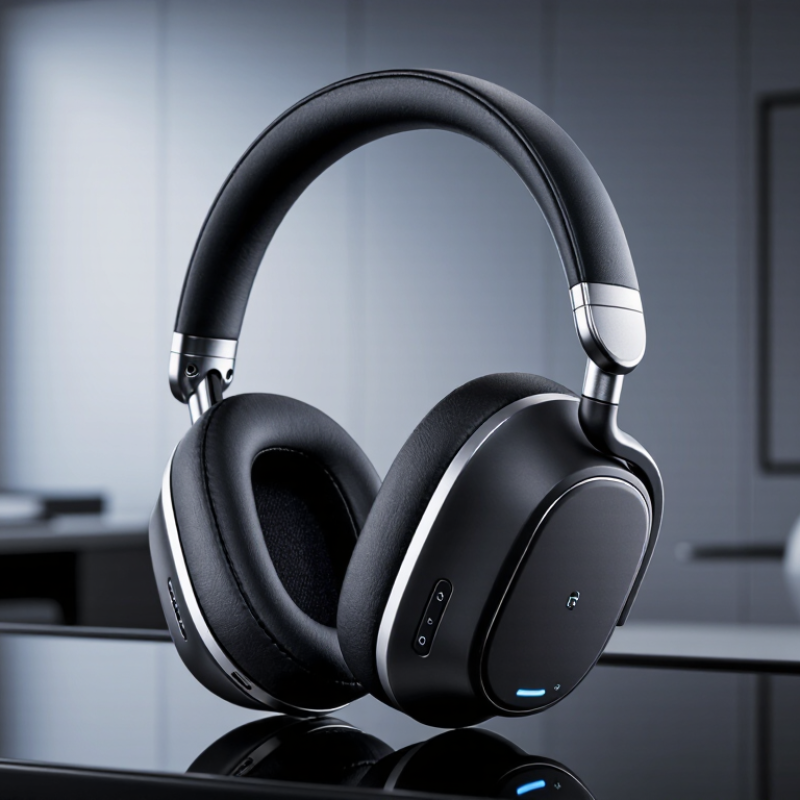
Over-ear ANC headphones combine sealed earcups, microphones, and digital signal processing to reduce external noise. According to Grand View Research, the global active noise cancellation headphones market was valued at approximately USD 12.6 billion in 2023. Its forecast indicates continued growth through 2030. Buyers should treat market forecasts carefully. They show direction, not guaranteed factory demand.
For supplier evaluation, request attenuation results across 100 Hz, 500 Hz, and 1 kHz. Low-frequency performance matters on aircraft and buses. Check battery life with ANC enabled, not in standby mode. A practical target is 30 hours or more, but test samples may differ. Bluetooth qualification, IEC 60268-7 audio testing, and IEC 60529 ingress ratings provide useful reference points. EN 50332-2 testing can also support safer maximum sound-pressure claims.
Do not judge performance from one impressive sample. Ask for three production samples and compare channel balance, hinge noise, microphone clarity, and charging temperature. A 2024 Futuresource Consulting report identified personal audio as a competitive, specification-driven market, where comfort and listening time strongly influence purchase decisions. That matches real buyer experience: a lightweight headband can matter more than a codec. I would also review ISO 9001 records and independent laboratory reports. Still, paperwork is not proof of consistency. A quiet showroom test can hide pressure points after two hours. Suppliers should disclose firmware limits, replacement-pad availability, and ANC performance changes after updates.
| Evaluation Category | Buyer Metric | Recommended Buyer Benchmark | Relevant Technology or Standard | Supplier Evidence to Request |
|---|---|---|---|---|
| Active Noise Cancellation | ANC attenuation performance | Compare performance using the same test fixture, noise spectrum, ear-cup fit, and measurement distance. Avoid evaluating products only by a single advertised decibel figure. | Feed-forward, feedback, or hybrid ANC architecture; acoustic test methodology should be documented. | Independent laboratory report showing test conditions, frequency bands, seal conditions, and repeatability. |
| ANC Functionality | Listening modes | At minimum: ANC on, ANC off, and transparency or ambient mode. A configurable level or wind-noise reduction mode is useful for premium applications. | Adaptive DSP, external microphones, internal microphones, and digital filter control. | Engineering sample demonstration, mode-switching test, and microphone placement drawings. |
| Audio Performance | Frequency response | A published response curve is more useful than a broad nominal range. The commonly stated nominal audio range is 20 Hz–20 kHz, but actual response tolerance should also be provided. | IEC 60268-7 is applicable to headphones and earphones measurement considerations. | Frequency-response graph, left/right channel data, test fixture details, and tolerance limits. |
| Audio Performance | Total harmonic distortion | Request THD at defined sound-pressure levels and frequencies rather than accepting one unspecified percentage. Lower distortion is generally preferred, especially at higher output levels. | Electroacoustic measurement procedures should state level, bandwidth, weighting, and fixture configuration. | THD+N report at 94 dB SPL and at the product's maximum rated output, with test conditions. |
| Wireless Connectivity | Bluetooth version and profiles | Bluetooth 5.x is suitable for current consumer products, but version alone does not guarantee range, audio quality, or battery life. Confirm A2DP, AVRCP, HFP, and supported codec requirements. | Bluetooth Core Specification; A2DP for stereo audio; AVRCP for remote control; HFP for calls. | Bluetooth qualification information, interoperability test results, supported profile list, and codec declaration. |
| Wireless Connectivity | Wireless range and stability | Set a minimum open-area range and require stable audio through common indoor obstructions. Define acceptable reconnection time after signal loss. | Performance depends on antenna design, radio power, interference, codec, and operating environment. | Range test at a defined distance, obstruction layout, transmit device, firmware version, and packet-loss observations. |
| Call Quality | Voice pickup and environmental noise reduction | Require clear two-way speech in quiet and noisy conditions. Specify whether the product uses one or multiple microphones and whether wind-noise suppression is included. | Microphone beamforming, digital noise reduction, echo cancellation, and voice-processing algorithms. | Call recordings from both ends, test results in controlled background noise, and microphone sensitivity data. |
| Battery | Playback endurance | Define separate minimum runtimes for ANC on, ANC off, wireless playback, and voice-call operation. A practical buyer specification is often 30 hours or more with ANC enabled, subject to product design. | Battery capacity, amplifier efficiency, ANC processing load, volume level, codec, and temperature affect runtime. | Standardized runtime report including volume setting, codec, ANC state, firmware, battery age, and shutdown criteria. |
| Battery | Charging interface and charging time | USB Type-C charging is preferred. Specify time to full charge, minimum quick-charge playback time, and whether wired audio remains available during charging. | USB Type-C connector implementation; charging-current and thermal protections must match the battery design. | Charging curve, charger compatibility list, temperature monitoring, and protection-circuit test results. |
| Battery Safety | Rechargeable battery compliance | Use a documented lithium-ion or lithium-polymer battery with traceable cell information, protection circuitry, and production-batch identification. | IEC 62133-2 for portable sealed secondary cells and batteries; UN 38.3 for transport testing of lithium batteries. | Battery specification sheet, IEC 62133-2 evidence where applicable, UN 38.3 test summary, and safety data sheet. |
| Comfort and Fit | Headband and ear-cup ergonomics | Request adjustable headband range, ear-cup internal dimensions, product mass, clamp-force data, and replaceable cushion options. Fit should remain stable without excessive pressure. | Ergonomic performance is affected by cushion material, headband distribution, seal, and product mass. | Dimensional drawings, mass measurement, clamp-force curve, wear trial across multiple head sizes, and material samples. |
| Acoustic Seal | Passive isolation and leakage | Evaluate the ear-cup seal separately from electronic ANC. Consistent sealing is important for bass response, ANC performance, and leakage control. | Cushion geometry, foam density, fabric cover, hinge alignment, and ear-cup pressure affect isolation. | Isolation measurements with ANC disabled, leakage test at defined playback levels, and fit evaluation on multiple users. |
| Durability | Mechanical reliability | Define cycle requirements for hinges, sliders, buttons, folding mechanisms, and ear-cup rotation. Require a documented failure-rate target for mass production. | Product-specific validation plan; relevant environmental and mechanical test methods should be stated in the quality agreement. | Hinge-cycle, button-cycle, drop, torsion, vibration, and transport-simulation reports with sample sizes. |
| Environmental Resistance | Sweat, dust, and operating temperature | If used for commuting or light exercise, specify an ingress-protection rating only when the complete product has been tested. Also define storage and operating temperature limits. | IEC 60529 IP Code may be used when an applicable enclosure rating is claimed; headphones are not automatically waterproof. | IP test report from an accredited laboratory, temperature and humidity test data, and limitation statements for microphones and charging ports. |
| Materials | Restricted substances and material traceability | Require declarations for plastics, metals, coatings, adhesives, cushions, cables, and packaging. Maintain batch-level traceability for critical materials. | EU RoHS and REACH requirements may apply depending on the destination market; local regulations must be confirmed. | RoHS test report, REACH declaration, material composition list, supplier declarations, and change-control procedure. |
| Market Access | Regulatory approvals | Select approvals according to the destination market. Wireless products commonly require radio, electromagnetic compatibility, safety, and chemical compliance documentation. | Examples include CE requirements for the European market, FCC requirements for the United States, and UKCA requirements where applicable. | Applicable declaration of conformity, laboratory reports, test configuration, technical file availability, and label artwork. |
| Firmware | OTA updates and software stability | Specify supported mobile operating systems, firmware-update process, rollback behavior, data handling, and the minimum software-support period. | Firmware can affect ANC tuning, Bluetooth compatibility, battery reporting, and call performance. | Firmware release procedure, update test matrix, defect-response SLA, version-control records, and sample update demonstration. |
| Quality Control | Production consistency | Establish incoming, in-process, and final inspection requirements. Critical characteristics should include ANC output, channel balance, charging, buttons, wireless pairing, and battery current. | AQL sampling may be included in the quality agreement; critical safety defects should have zero acceptance tolerance. | Control plan, inspection checklist, calibration records, AQL level, defect classification, and pre-shipment inspection reports. |
| Customization | OEM/ODM capability | Assess acoustic tuning, industrial design, packaging, firmware customization, accessory development, and engineering-change responsiveness. | Customization may change acoustic response, certification scope, battery behavior, tooling, and minimum order quantity. | Anonymized project case studies, development schedule, tooling quotation, engineering resources, and prototype-to-production process. |
| Commercial Terms | Total landed cost | Compare unit price together with tooling, testing, packaging, freight, duties, spare parts, warranty reserves, and software-support costs. | Incoterms, payment terms, order quantity, packaging configuration, and destination regulations materially affect landed cost. | Itemized quotation, Incoterm definition, packaging dimensions, production lead time, warranty terms, and replacement-part pricing. |
| After-Sales Service | Warranty and spare parts | Define warranty duration, covered failures, return-material authorization procedure, repair or replacement policy, and availability of cushions, cables, hinges, and batteries. | Service quality should be measured by response time, closure time, return rate, and recurring-defect analysis. | Written warranty policy, service-level agreement, spare-parts list, failure-analysis format, and quarterly quality review process. |
Sealed earcups block some sound physically. Microphones detect remaining noise, while digital processing creates an opposing signal.
Ask for attenuation results at 100 Hz, 500 Hz, and 1 kHz. Low frequencies matter on aircraft and buses.
Target at least 30 hours with ANC enabled. Standby figures can look generous. Test at realistic listening volume.
Bluetooth qualification and IEC 60268-7 audio testing offer useful references. IEC 60529 ratings describe ingress protection.
Request three production samples. Compare channel balance, hinge noise, microphone clarity, and charging temperature.
A lightweight headband may feel better after two hours. A quiet showroom test can hide pressure points.
Request monthly capacity, defect records, inspection procedures, and lead-time evidence. High output claims need documentation.
OEM projects follow an approved design, packaging plan, and acoustic specification. ODM projects adapt existing designs and circuits.
Check folding strength, replaceable pads, microphone clarity, charging behavior, and ANC changes after firmware updates. Documents are not proof of consistency.
Start with a small pilot order. It may reveal more than a polished factory tour, though results can still vary.
This guide presents a practical overview of China’s Over Ear ANC Headphones supply market for international buyers. It explains the core technologies behind active noise cancellation, including microphone arrays, digital signal processing, transparency modes, battery systems, wireless standards, codec support, and relevant product safety and radio compliance requirements. It also outlines how to assess market development, manufacturing capacity, export readiness, and product specialization without relying on brand names or unverified claims.
The supplier comparison focuses on OEM and ODM capabilities, production scale, model variety, ANC performance, battery endurance, sound quality, connectivity, certifications, and quality-control procedures. Buyers will also find useful evaluation points for MOQ, unit pricing, tooling costs, sample approval, lead times, warranty policies, packaging customization, after-sales support, and compliance documentation. Together, these criteria provide a structured way to compare Chinese manufacturers, reduce sourcing risks, and select reliable partners for different sales channels and target markets.